Posted in Writing

NaNoWriMo!

So November is National Novel Writing Month and I imagine that a lot of you who read this blog are lost in worlds of your own creation, aiming to have at least 50,000 words on the page (or the screen) by the end of month. I’d love to hear about any stories you’re working on! Share a link to your NaNoWriMo profile if you like.

I’m also curious to hear about NaNoWriMo success stories. Who’s reached the word count goal in the past? Did you go on to finish the novel? Did you query, publish or self-publish or move on to a new work? (Or both?)

I’m asking a lot of questions and would like to share my own NaNoWriMo experience, but I don’t have a proper tale to tell! I’ve never officially participated in NaNoWriMo. This year I’m too busy with work writing and I’m juggling three WIPs (one YA, one MG and one “classified” short project) and don’t want to start yet another new work.

In the past, though, I sort of participated twice–I’m thinking 2007 and 2009 (but don’t quote me on that). I didn’t think I could officially participate because you’re supposed to write something brand new, if I understand correctly, and I was in the midst of my never-ending first draft for a YA book (120,000 words in the end and still not half way finished, ha) that took me nine years to finally abandon once and for all, after I mined the very best 5000 words or so and melded it into my first completed novel. So both of my unofficial NaNoWriMo experiences I worked on that manuscript, only I didn’t follow the rules in another way: I wasn’t aiming for 50,000 words. I was just determined to write half an hour a day at minimum in honor of the occasion, and that’s what I did. I even kept that up for some time into December.

I did also have similar experiences earlier this year. For one, I wrote 58,000 words in nine days early in the year when I had the inspiration for what would become my first completed draft of a book. In August of this year, I eked out almost another 50,000 words on a WIP because I had less work than usual. This time, it took me the whole month, and not every day of writing went smoothly.

And of course, I write tens or even hundreds of thousands of words each month for work, but that’s not quite the same!
Posted in Writing

Handwriting or Typing?

Do you write your first drafts by hand or on a computer? (Or by typewriter? Who knows, maybe some nostaligic people still use those!)

This question seems less and less relevant in the digital age, but I’m still surprised to hear about authors who prefer to handwrite their works, at least initially. I’m so used to my computer that it just seems easier for me to type my ideas out, and I type pretty quickly, too, although not via the proper Mavis Beacon-approved method. (At some point that method, taught to me in elementary school on an old 1980s Mac, morphed into a three-fingers-on-each hand thing that I’ve used ever since.) Also, from years of school, I’ve learned that my taking notes by hand in a hurry amounts to chicken scratch. I’m not sure the method of handwriting my manuscripts would be able to keep up with the pace at which my brain comes up with the words on a good writing day–sometimes even typing is too slow.

That said, I tried it once a few years ago. (When I was really young, I wrote stories in notebooks all the time before I typed them up, but I wonder if that was more because of a limited access to computers.) By the time I scratched out half the words on the page, I knew I wasn’t getting anywhere, and back to the computer I went.

I do, however, handwrite letters to pen pals. Yes, old fashioned snail-mail pen pals; I started pen palling when I was 7 and have never fully stopped, although I admit my letters are far less frequent these days and I keep in touch with a large number of my pen pals online rather than by snail mail. There’s something fun about receiving handwritten notes from a friend across the country or the globe, and I wonder if this tangibleness is part of the appeal for authors who write their works by hand.

Or maybe it’s about being better able to shut out distractions and not having to deal with the headache of staring at a screen for hours on end. I’m definitely not a fan of either of those downsizes to typing.

Do any of you prefer to handwrite? Do you know why? Or do you prefer typing first like me?

Posted in Writing

Multi-Person Writing Projects

There’s much to be said about working on a writing project by yourself. When you’re tackling the first draft of a project, it’s all your own. Of course, if all goes well, you’ll have multiple readers and professionals down the line giving you input so you can shape the story or poem into the best possible version of your vision… But what about projects that you tackle with other writers right from the start?

I haven’t done it too often, but one of my favorite creative writing exercises is where one writer writers one sentence, another writer writes the next, building off that first sentence, and so on and so on. I’ve participated, but I actually haven’t seen any finished products.

I also love alternatively writing with a friend. I’ve written a comic series script with one of my friends and I’ve read a work in progress she writes as letters from one character to another with another writer. It’s a really fun, inspiring way to write. Can’t think of where a story goes next? Leave your part on a cliffhanger and let your co-writer figure out what comes next!

In honor of multi-person writing projects, I’ll go ahead and write the first line to a short piece of fiction. The first commenter can write the next line, and so on! (I apologize if my delay in approving comments gets things out of whack, but it’s all in fun.)

“If Pepper had to explain the origin of her name to one more stranger one more time, she was going to have to start carrying pepper spray with her wherever she went.”

Posted in Writing, Writing: Help

Happy Labor Day! (Are You Laboring?)

Happy Labor Day to the rest of you in the US! If you’re a writer, particularly a freelance one, holidays are hard to take off, though. If you shimmy your schedule around just right, you may be able to take a day off here and there, but usually they’re out of the question. Especially if you’re being good and writing creatively every day like you ought! In which case, even when you don’t have the business writing to do, you’re still keeping up the discipline by working on a WIP.

An advantage of being a freelance writer, though, is that you can make your own schedule for the most part, and there are a number of days where you work fewer than eight hours. (And some days when you work more, ack. I try to avoid those. I never once pulled an all-nighter in college, but I have for some clients!) Of course, there’s always so much else to fit into any given day: cleaning, cooking and running errands… I don’t think I’ve experienced boredom outside of things like waiting in lines in years.

This week I have a huge freelancing project from one of my favorite clients, one that may extend for a number of months. I’m also roughly 10,000 words from finishing the first draft of the YA WIP that I started earlier this year and that I’ve been determined to work on almost every day for over a month now. (And boy, is it taking a lot more out of me than the first completed book!) I have big, exciting edits for another project. I have two other WIPs not touched in a while… Oh, and I have to live outside of staring at my computer at some point, too.

So how have I managed it so far? And why am I here at the blog? Because I’ve finished my work quota for the day. (Admittedly, I haven’t picked up the WIP quite yet, but I will.) So far (after fighting off panic about how much I need and want to do over the next few weeks) I’ve decided to:

  • Get the work writing done right away in the morning. I need to work on the non-fiction stuff when my mind’s still focused and I have the drive. Whenever I feel my drive slipping, I keep telling myself I’ll be done after lunch, and then I’ll have the afternoon to devote to other projects.
  • Turn distractions into a reward. I can easily spend an hour just goofing off at my favorite websites first thing when I get online if I choose (it’s nice and brain-numbing). Not so this week. I check my email, shut off the Internet, write two articles, check one fun website, rinse and repeat…
  • Stick to the WIP. I’ve spent too many weeks working on this one nearly every single day to give up now when the end is so close. (And I’m at risk of never wanting to pick it up again after all it’s put me through!) I just need to be more lax when it comes to word count. My best days were 2000-3000 words, but now I need to be okay with 500 on any given day, and then I can focus on other projects.
  • Take breaks! When I waste time goofing off online, I feel guilty spending too much time away from the computer doing anything more substantive than a quick run to the washing machine to start a load of laundry. When I’m disciplined, I feel I deserve a 15-minute break to read or step out for fresh air. It recharges me, and I don’t feel guilty.

So far, so good, I don’t feel like a burn out is imminent. What do you do when you’re incredibly busy, but there’s so much you need and want to do? How do you fit it all in?

Posted in Writing

Where Do You Write?

My boyfriend has a pretty nice desktop set-up as his personal computer. More than once, he’s told me he doesn’t understand why I don’t want the same, and I instead rely on my laptop. When I first got my own laptop in 2004, I thought it was the coolest possible way to write. I didn’t even get wireless in my house for another four years. (Late to the game, I know.) At first I was just writing essays for school (and the occasional creative work, of course), but when I became a freelance writer, I’d go the extra step of going online with my desktop with its wired Internet connection, getting assignments and going back to my laptop to write. Why? Because I like to be comfy when I write!

Over time, my “office” set up evolved. Despite loving the portability of my laptop, I actually didn’t like keeping it on my lap. I missed my mouse. (“Why be so stubborn and keep using the laptop?” the boyfriend asks.) So once I finally got wireless connectivity, I turned to something aimed at college students: a small laptop desk, which I’ve upgraded from ugly plain plastic to faux wood over the years. It allows me to angle the laptop (a must, since I prefer to type at an angle) and there’s space for a mouse, too. I work on a futon bed (half folded up to provide back support) every day and it’s pretty sweet! (This is not where I sleep, by the way. Who sleeps in their “office”? Ha.)

I do have a crude desk and a nice desk chair (the latter courtesy of the boyfriend, trying to tempt me to a traditional desktop set-up, perhaps) I use for a bit a few times a week when I feel like a change. I also once tried to type at a desk on my porch, but I couldn’t see the screen too well with the bright outdoor light. (I’m not much of an outdoorswoman anyway!) I’ve also done some work on my boyfriend’s netbook at a Starbucks a few times and even once at a McDonald’s (the latter of which was incredibly icky…) out of necessity while on the go, although I don’t recommend it. Personally, I prefer being alone when I work. And I love listening to music (mostly film, TV show and video game soundtracks–I can’t listen to songs with lyrics when I work or I stop working and start singing!), not hearing the “Whirrr….” of coffee being made. Of course, in college, I worked in the library a few times, but I borrowed the school’s laptops to do so; I’ve always been strangely protective of my laptop and refuse to bring it anywhere outside of the home. (What if it breaks?! I wouldn’t even bring a laptop on my vacations until I had a new one and could bring the older model. It’s heavier, but at least I wouldn’t be crushed if it broke or got lost.)

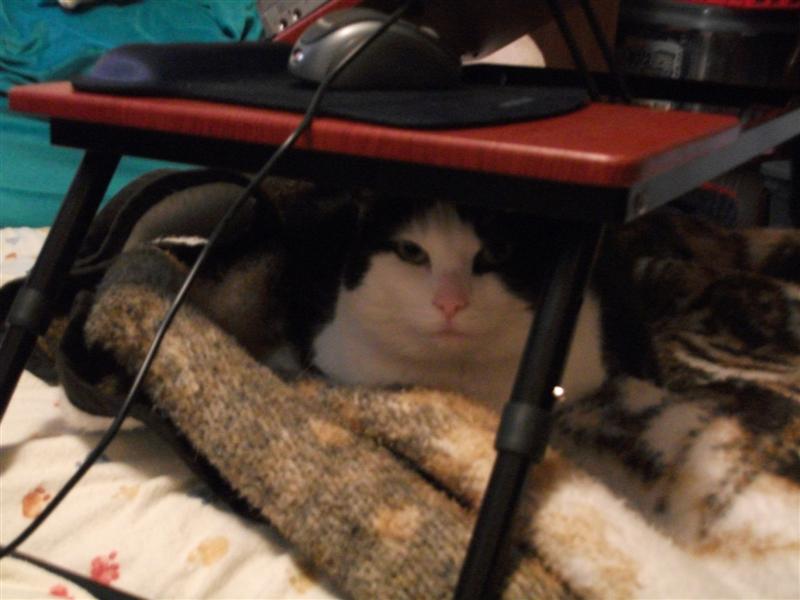
My cat loves my strange “office” set-up, too! She sometimes sits on my legs and other times curls under the desk, blocking me from stretching out my legs. (Just kick her out? Never!)

She’s not moving.

Where do you write? Does the environment in which you write affect your concentration? Do you like listening to anything when you write?

Posted in Writing

Product/Pop Culture References in Writing

The work in progress that’s been getting the bulk of my attention lately is contemporary. Or should I say “roughly contemporary.” I don’t plan on explicitly stating what the year is, but I do date it unintentionally because I describe events that took place recently as having taken place “last year.” I also drop product names like I would in everyday conversation whenever I feel it’s appropriate. I even mention celebrity names.

It’s a strange feeling for me. My finished manuscript is fantasy (yay for making up a world from scratch!) and my other WIP doesn’t feel like it needs any particular setting other than “roughly about whenever you’re reading it,” so there aren’t any product or pop culture references. In this one, I just felt like the characters needed to discuss things like a real person would. But then again, whenever I read these things in other books, I can’t help but feel like the book is dated.

When I take a look at my other stab at contemporary YA fiction (part of the mess that eventually morphed into the finished manuscript, which I love–and there’s no contemporary in the final product), I cringe for more reasons than one, but one passage in particular stood out. I had the narrator commenting on a iPhone like it was a brand-new thing. Now it’s several years old, and the character’s response to it seems outdated. By the time this WIP sees the light of day (which I hope it does!), will I be left with a similar feeling?

Do you think peppering a contemporary manuscript with product names or pop culture references is acceptable or distracting? Do you think it dates the action too much?

Posted in Writing, Writing: Help

Ending at the Beginning

It’s no secret that the beginning of a manuscript has to entice people to keep reading or the rest of your manuscript may never see the light of day, no matter how wonderful and exciting it becomes later on. Actually crafting that compelling opening is easier said than done, though–at least for me.

When I sat down to write the manuscript that got me an agent, I wrote the scenes that my brain told me came first. Meanwhile, I was also incorporating a little bit of an old manuscript I’d been working on for years. (See this entry.) The result was an odd mishmash of chronology for the first four chapters or so. One of my beta readers thought the jumps odd and wanted more clarification, particularly when it came to worldbuilding. (The manuscript is fantasy.) I thought about it and added a few more passages I thought clarified things and I was ready to go.

Of course, most (but not all) agents ask for a sample of the manuscript along with the query. I only had 5 or 10 (sometimes a bit more) pages to grab their attention. Partial and full requests came in… And the vast majority were only from agents who had requested queries only (no sample pages) for the first e-mail. I started wondering if that meant my concept was enticing enough but not my first few pages…

And then I got an R&R on a full request. The problem? The beginning, of course! The agent agreed with my beta reader (maybe they’re really in tune–that agent was my beta reader’s agent by then!): I needed to fix up the beginning and work on clearly worldbuilding. So that was two people who thought my beginning needed work–and maybe more, and the others who rejected it didn’t have time to tell me.

I took a time out from sending queries and spent a slow three weeks reshaping the beginning. I cut long scenes, rearranged ones I wanted to keep and cut, cut, cut passages. Then I drafted a new first chapter–twice. I didn’t much like my first attempt at a new beginning. Then I was struck with a different idea, and I wound up writing two completely new chapters. This version started with action, and I used that action to worldbuild. At first I was wary about re-doing the beginning, but I loved the final result!

I sent out the revision and continued to query other agents with my brand new beginning. Material requests rolled in, and this time they were from agents who saw sample pages at the start! I got a few passes, but of those who took the time to detail their reasons, all were complimentary–particularly about my worldbuilding! And, of course, it was this beginning (10 pages with the query) that netted the full request and then my first offer of representation.

I’m learning. Both of the beginnings of my two WIPs start with action. I like them–but at the same time, I wouldn’t be surprised if I have to go back and tweak the beginning at the very end!

How do you write beginnings? Do you fix the beginning later or think of a compelling image to start the book before you start?

Posted in Writing

Hearing Your Manuscript’s Voice: Narrative Mode

The work-in-progress that’s been getting the most attention from me lately (despite occasional feelings of this-sucks-itis, only overcome by thoughts of but-you’re-practically-almost-finished-so-keep-going) is in the third person. And it’s actually the first time in years and years that I’ve written a story in third person. It’s so confusing to my brain that I accidentally wrote in first person for a few paragraphs the other day… Never mind that I have two main characters, which is actually part of the reason why I decided to tell the tale in third person. That, and it’s middle grade and the MG books I’ve read tend to be third person more often than not.

My other WIP is first person, although I can’t even blame that for mixing up the two works, as the main characters WIP #1 are about as different from main character in WIP #2 as can be. Still, besides the fact that WIP #2 is YA and a good chunk of the YA books I read are in first person (as is the manuscript-on-submission), there is absolutely no way I could tell this story from any other point of view. The story literally hinges on his perception of the world; from anyone else’s, there wouldn’t be as much of a plot. Any filmed version of the story (ha ha) would have to adjust to the way he sees the world; I don’t even know if it could be done. The voice of the manuscript is essential to the story as a whole.

I think that’s what I like about first person narrative, even if it isn’t always so integral to the plot as it is in WIP #2. Yes, I know that third person narrative scenes tend to have a POV or two, but you may not get so deeply entrenched in a character’s head, and feel all of those messy feelings and biases as the character reacts to the situations you throw at him or her. Third person works better for WIP #1 because the plot is more important than any character’s POV, but still, I wonder if the feeling of detachment I have as I write it is what’s slowing me down. (Manuscript-on-submission’s best words-written-in-a-day stat: about 10,000 [I kid not…]. WIP #1: about 1000…. If I’m lucky…)

How do you find your manuscript’s voice? Do you prefer writing first or third (second seems like a choose-your-own-adventure novel to me, but I’m sure it’s been done effectively!) or switch freely between the two from work to work? Do you prefer reading in any particular narrative style?

Posted in Writing, Writing: Help

The Soul-Sucking Synopsis (I Exaggerate, but Barely)

Ask virtually any writer, published or unpublished, who’s gotten as far as the querying stage at least, and they’re bound to agree: when it comes to writing the one- or two-page book synopsis or writing the entire tens-of-thousands-of-words manuscript, the latter is probably easier. I’m not kidding.

Luckily for me, my agent was one of the types who never asked for the synopsis (and he agreed with me on how awful they are)—not even after I signed with him! (It may be needed in the future, of course, so I can’t hold a digital fire and delete the wretched things off my hard drive…) But I wrote several versions before I started querying anyway because a fair number of agents do ask for one, either upfront or after they request further materials from you.

My first attempt was a joke. I tried writing about two sentences per chapter, but I couldn’t stick to it. In the end, I had about five single-spaced pages, which wasn’t going to fly. (I hear tell that sometimes agents will request 5-10-page+ synopses from you, but probably not until they sign you, and perhaps not even then, so don’t worry about writing a long one while still querying.)

When an agent requests a “one-page synopsis,” from what I understand, you can write it “Internet style,” which is single-spaced, chunk-like paragraphs and two spaces between paragraphs (see this blog entry as an example). The “two-page synopsis” is double-spaced and manuscript style, with indented paragraphs and no extra spaces between paragraphs. I found that the two are actually almost the same, when you take into account the spacing. The two-page one did allow for a few more sentences, though. (And every sentence you can wring out of the space counts. Really!) Expect both versions to be between 500-1000 words, and the closer to 500 words, the better. Yes, you have to distill your entire book into fewer than 1000 words. (I wound up with about 600 for the one-page and 760 for the two-page.)

I’m probably not the best source of advice on the subject, as I’m still not that proud of my synopses. Still, I’d be glad to share the tips that helped me rip the final results from my brain over a long period of three weeks and several drafts:

  • Aim for the limited space from the start. Originally, I thought I’d write up a summary of the book as I pleased and cut out any extra words later. Yeah… That wasn’t going to cut it when during my first try, I came up with a 3500-word version I needed to cut down to as close to 500 words as possible. I started over from scratch without even looking at the first version.
  • Follow the greater plot and cut out the subplots. If you ever write a longer version, you can put the subplots in there, but when every word is crucial, you’ll have to skip entire storylines. I actually skipped almost all of my beginning in which I set up the world, except for a couple of sentences that explained the world clearly. (When I changed the beginning of the manuscript drastically, I didn’t even have to change the synopsis since I never was able to fit in information about the start!) It helps that you have to…
  • Name only three (or four?) characters. The main character is a given, but most of the characters s/he interacts with will have to be known by their roles such as “Tanya’s sister” or “the old neighbor.” Other characters you might choose to name are any love interest(s) or antagonist(s). Everything I read said to name no more than three characters, but I could not do mine without four. Maybe some agents/editors are flexible… Oh, and by the way, put the names in all-caps the first time you write them in the synopsis: Sixteen-year-old TANYA RICHARDS ….
  • Try to add your voice. I had a lot of trouble with this one. You don’t want your synopsis to be boring—you’re probably using it as one part of your package to sell your book to an agent or editor—so it’s got to have some of that query-like, back-of-the-book-type flair. Try to project the same tone you use to narrate your book. (By which I don’t mean write in first person if your manuscript is in first person. Write in third person always with synopses.) I don’t think I quite did that (it was hard enough for me to get the story out in such limited space), but I know my fellow writer and beta reader did with her sassy book synopsis.
  • Delete unnecessary words. After the horrible first attempt at a synopsis, I wrote one that was about 1100 words. That’s the one I was able to get down to two pages and then one page. To do so, I deleted as many adverbs and adjectives as I could and made sure every sentence added something important to the summary. If not, it had to go, no matter how much it hurt to cut it.

Have you written a synopsis? What tips worked for you?

Posted in Writing, Writing: Help

The Query Conundrum: Tips for Creating the Perfect Query

During my entire agent search, I visited writing forums and writer blogs on pretty much a daily basis to get tips on how to get my book out there. (Also to distract myself from all of the waiting that’s unavoidable in this business!) One topic I saw discussed time and time again was the query. Some people claimed to spend weeks on crafting the perfect query–and sometimes even then, they’d go back and do a second or third version of the query for the same book. They’d post queries for other writers to critique and compete in agent-sponsored contests for professional feedback on their queries. It’s clearly a major source of frustration.

Me? I wrote my query in about half an hour and never revised it. I did ask one vague question on a forum before I began, though, having to do with how to phrase the “it’s a stand-alone story with series potential” aspect and if I should mention the unsatisfying (?) but still conclusive (?) ending I hoped would cause people to want more but not scare away anyone who wanted a stand-alone book. I also sought feedback from my beta readers, but they both thought it was fine. Of everything in the writing process, I spent the least amount of time on writing the query. (And don’t worry, not everything went so smoothly for me–my multiple stabs at the dreaded synopsis took weeks and weeks… A story for another day!)

The query resulted in about a 10% interest from agents (i.e., requests for partials/fulls), although of course it obviously wasn’t to every agent’s taste (which accounts for the other 90%!). Still, I was pretty confident in the query, especially since pre-major revision to the beginning of the book (which inevitably changed the first 5/10/30 pages a chunk of agents ask for with the query) I was pretty sure my query was getting more response than my pages, since almost all of the requests pre-revision were from the agents who only got the query with no sample pages (their preference).

..But I’m not going to post the query. Sorry! The manuscript’s being prepped for the submission stage, and I’m not yet comfortable sharing the details online. (Not that anyone’s going to steal it, but even so!) But I will share some tips I hope can help you nail that perfect query:

  • Read the back/inside dust jacket teasers for your favorite books. This is essentially what you’re trying to recreate for your book. Break down what those writers (not necessarily the authors themselves) did to get you to pick up the book with just a few sentences. They didn’t give away the ending, of course, but they set up the conflict, introduce the main character (and a central secondary character or two) and hint at the major problem behind the plot of the book.
  • Think of yourself as a salesperson. Maybe one reason I enjoyed writing my query was because my other hat as a writer tends to lean towards salesmanship. (Whatever my clients’ clients have to sell, be it product or service, I spend hours writing to try to convince the random web visitor they can’t do without it, even if I’d never heard of it until I got the assignment… Without being too knock-you-over-the-head about it!) The few sentences in a query need to “sell” the book; they need to be so dripping with voice, danger, conflict, and/or some form of drama, they scream, “Pick me up and read me to find out more!”
  • Get critiqued. If you’re struggling, there’s nothing wrong with reaching out to your beta readers, writing forums, and agent-sponsored contests for help! That’s what they’re there for.
  • Query in batches. Test to see if your query is getting any response. If you query 10-15 agents and not a single one requests material, it may be time to re-write the query from scratch. (Or your problem may lie in the sample pages. Try a few agents who ask for the query only at the start to see if it’s the query or the pages that’s the culprit!)
  • Double-check the individual agent’s preferences. This involves more than just knowing whether or not the agent reps works in your genre or wants samples pages/a synopsis from the start (although paying attention to these points is essential, too!). Some agents–although they’re rare from what I saw–actually do want the whole story spoiled in a query. Others are very strict about the length of the query or want to know whether or not you’re sending the query out to other agents at the same time. (Tip: DO send it out to multiple agents. The process takes too long to limit yourself to one agent at a time!)
  • Break it into manageable chunks. My query was probably a tad longer than what I’d seen in all of the advice–which sometimes says the thing ought not to be more than three or four sentences or so. But don’t make it too long. (The whole query letter ought to be no longer than a page–and that includes the bio, info about word count and genre, and introduction as well as the book teaser.) The actual book teaser part doesn’t have to stick to three or four sentences, but it should fit into these four categories:
  1. The hook. Most places say one-sentence. Mine was four (albeit very small sentences, intentionally chopped up for the effect of “voice”). Let this opening line (or lines) especially drip with the voice of your work. Let it say something unexpected–or better yet, twist something expected into something unexpected. It may be the furthest an agent reads into your query, so it better work to grab their attention! For example (totally made up story here), which is the better hook? “15-year-old Andy just found out he’s a fairy” or something like “Most 15-year-olds are looking forward to getting their learner’s permit so they can learn how to drive. Andy’s got to worry about learning how to control the glistening fairy wings that just sprouted from his back so he can stop floating in front of his friends.”
  2. The world. Not every story necessarily needs this part in the query, but mine did since it’s a fantasy. Explain briefly what kind of world your story takes place in, so the drama you’re going to allude to makes sense.
  3. The set-up. Explain where your main character finds him or herself at the beginning of the story and what kind of problems he or she faces before the big drama/action of the book kicks into gear. (Hint, a lot of times your main character will evolve from the person he or she was at the beginning by the end of the book; explain how he or she starts out in the query.)
  4. The conflict. Here’s the juicy part. Explain the main conflict of the book in one to three sentences and take us up to just before the big climax–without spoiling us about what that big climax may be. Leave it open-ended!

Do you struggle with queries? What are some tips that work for you?